
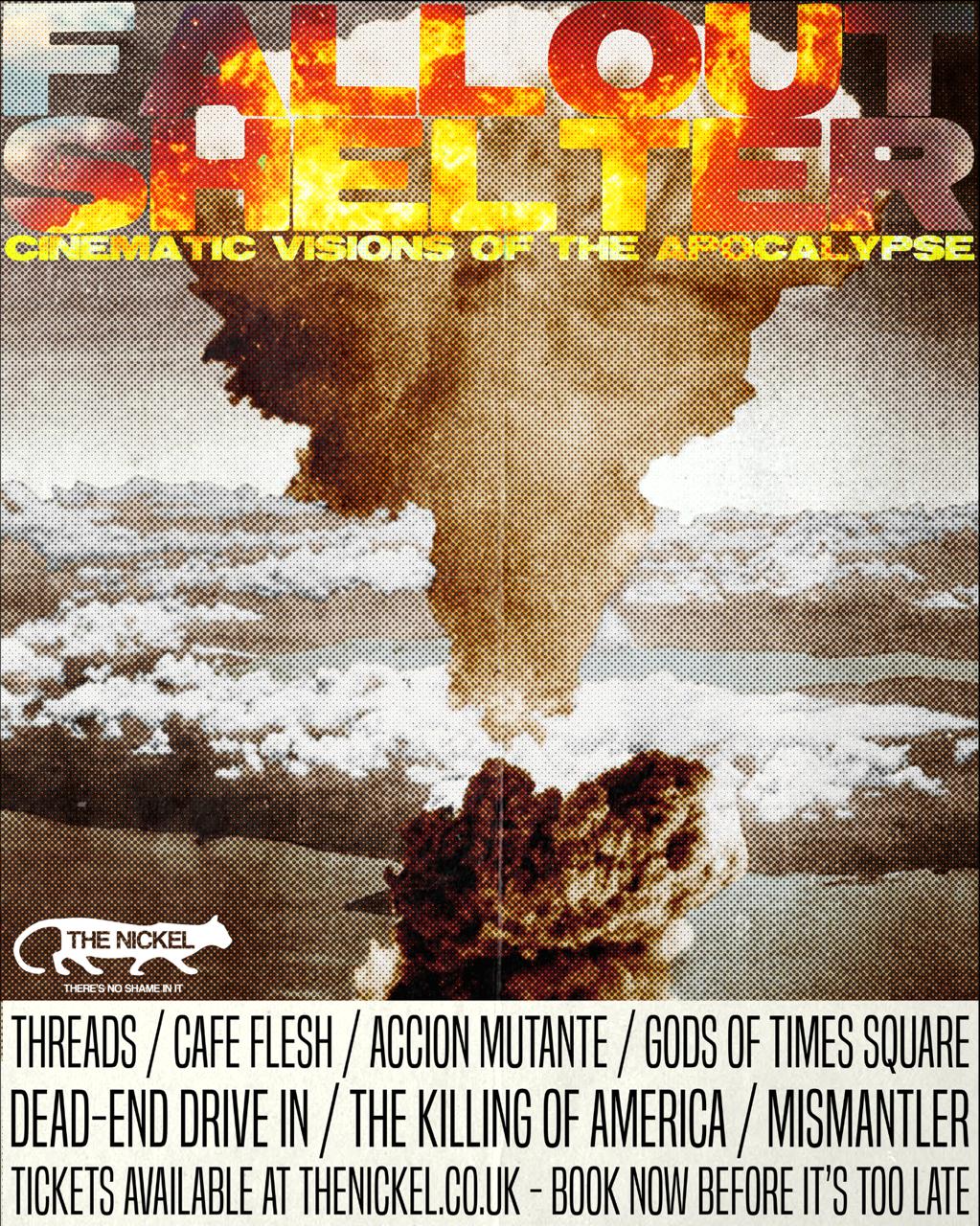
FALLOUT SHELTER
7 films in this collection
As we move ever closer to doomsday, we invite you to hunker down with us in The Nickel's FALLOUT SHELTER with these seldom screened apocalyptic visions.
Atom bombs, mutant survivors, post-nuke thrill seekers, religious fanatics, falling empires, dystopian futures and psycho-geographic journeys through a scorched, post-human world!
Atom bombs, mutant survivors, post-nuke thrill seekers, religious fanatics, falling empires, dystopian futures and psycho-geographic journeys through a scorched, post-human world!
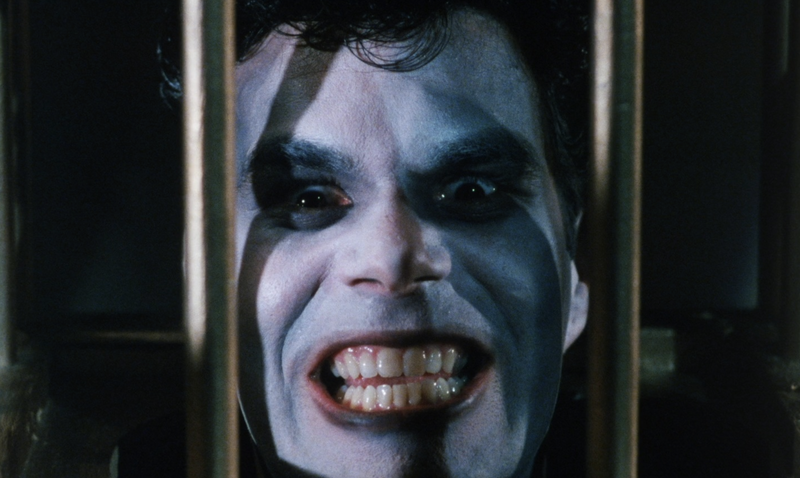
CAFE FLESH
(1982, USA, Stephen Sayadian)
75 mins18
In a post-apocalyptic world where most survivors are “sex negatives,” human intimacy has become a stage act performed for the immune few. At the surreal nightclub Café Flesh, performers cycle through bizarre, dreamlike routines while the uninfected audience watches with hungry detachment. When a man discovers he might not be “negative” after all, the revelation threatens the uneasy balance of desire and despair holding the place together.
A cult landmark of punk-infused erotica and midnight-movie surrealism, Café Flesh blends cabaret spectacle with dystopian melancholy. The result is a strange, intoxicating vision of lust, alienation, and performance at the end of the world.
A cult landmark of punk-infused erotica and midnight-movie surrealism, Café Flesh blends cabaret spectacle with dystopian melancholy. The result is a strange, intoxicating vision of lust, alienation, and performance at the end of the world.
Upcoming Screenings
No upcoming screenings
GODS OF TIMES SQUARE
(1999, USA, Richard Sandler)
118 mins15
Filmed over the course of the 1990s, Gods of Times Square is a street-level chronicle of New York’s most volatile crossroads during a period of accelerating commercial transformation. Stationed at the corner with a handheld camera, Richard Sandler records preachers, prophets, hustlers, conspiracy evangelists, and self-styled messiahs who command the sidewalks with competing visions of salvation and doom. As redevelopment advances and the neighbourhood’s rough edges are smoothed into tourist-friendly spectacle, the film captures a disappearing ecosystem of unfiltered expression, improvisation, and street-corner theology.
Sandler’s documentary operates as an urban ethnography: observational, patient, and attuned to the rhetorical rhythms of the individuals who populate the frame. Rather than editorialise, the film allows its subjects’ cosmologies — comic, tragic, apocalyptic, and deeply idiosyncratic — to overlap and contradict one another in real time. The result is a portrait of Times Square before its corporate remaking, a cacophonous public forum where belief, performance, and survival were inseparable.
Sandler’s documentary operates as an urban ethnography: observational, patient, and attuned to the rhetorical rhythms of the individuals who populate the frame. Rather than editorialise, the film allows its subjects’ cosmologies — comic, tragic, apocalyptic, and deeply idiosyncratic — to overlap and contradict one another in real time. The result is a portrait of Times Square before its corporate remaking, a cacophonous public forum where belief, performance, and survival were inseparable.
Upcoming Screenings
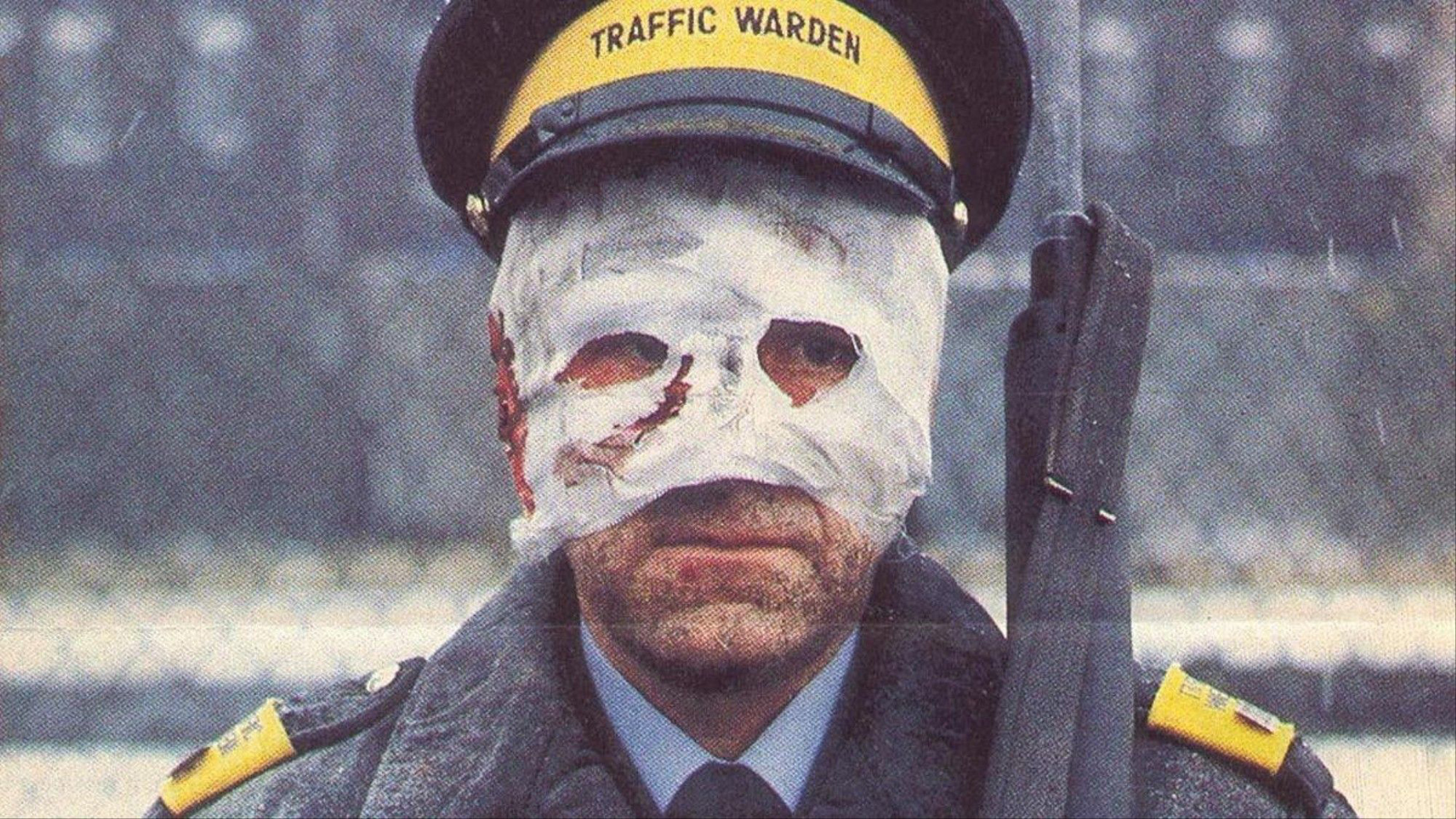
THREADS
(1984, UK, Mick Jackson)
112 mins18
Set in Sheffield during escalating geopolitical tensions, the film traces the lives of two working-class families as international brinkmanship gives way to nuclear exchange. In the aftermath, domestic routines collapse into chaos: infrastructure fails, governance disintegrates, and survivors confront starvation, radiation sickness, and the loss of social memory. The narrative’s documentary-styled progression — from pre-strike normality to long-term societal regression — renders the catastrophe with stark procedural detail.
Produced for the BBC and grounded in contemporary civil-defence research, Threads remains one of the most uncompromising depictions of nuclear warfare ever broadcast. Its quasi-verité approach, bleak temporal scope, and emphasis on institutional breakdown transform speculative fiction into a forensic study of vulnerability, capturing both the fragility of modern systems and the human cost of political miscalculation.
Produced for the BBC and grounded in contemporary civil-defence research, Threads remains one of the most uncompromising depictions of nuclear warfare ever broadcast. Its quasi-verité approach, bleak temporal scope, and emphasis on institutional breakdown transform speculative fiction into a forensic study of vulnerability, capturing both the fragility of modern systems and the human cost of political miscalculation.
Upcoming Screenings
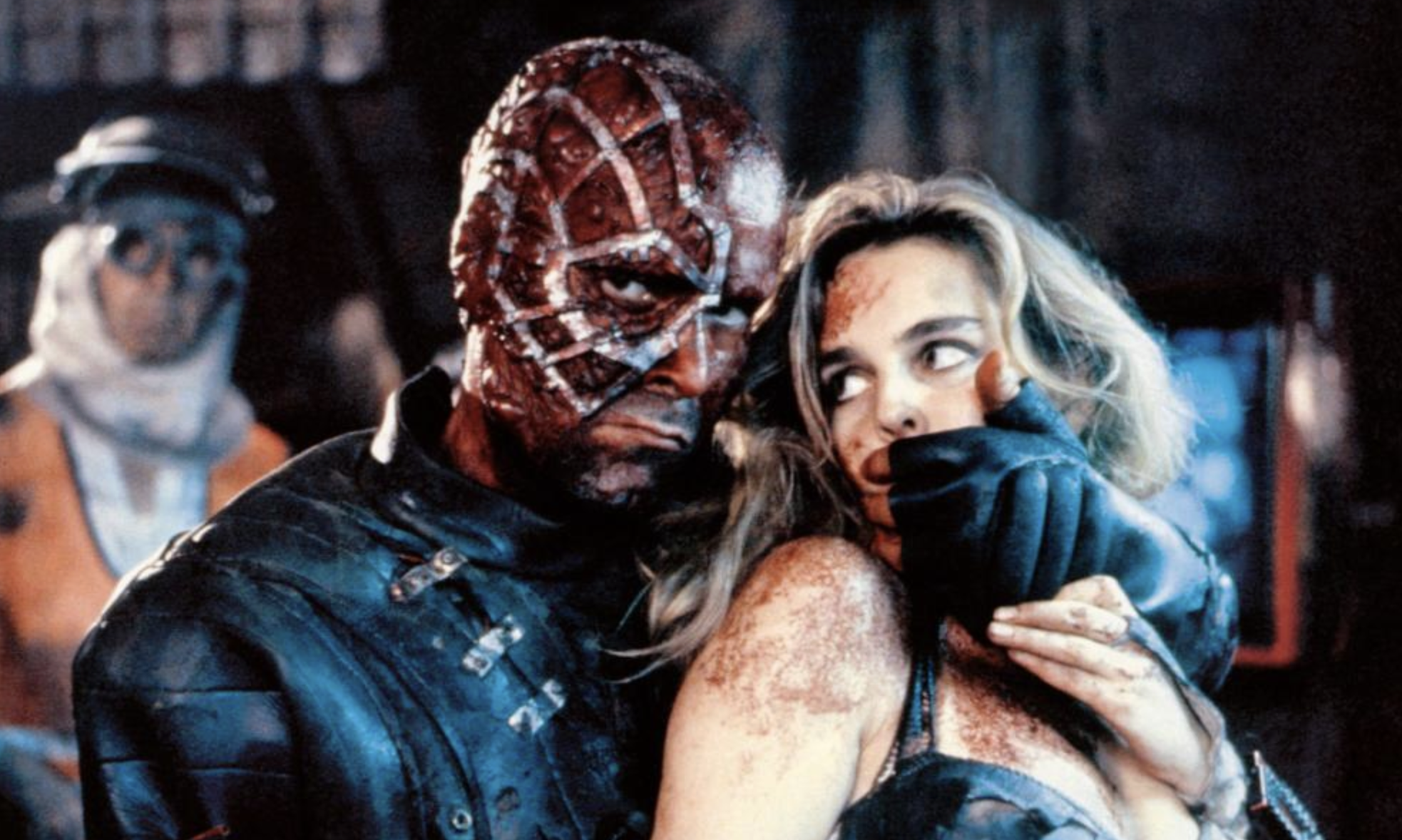
ACCION MUTANTE
(1993, Spain, Álex de la Iglesia)
97 mins18
BETTER THAN NOTHING presents
In a near-future dystopia ruled by the beautiful and wealthy, a militant cell of physically disabled outcasts — the self-declared “Acción Mutante” — wages a chaotic campaign of kidnappings and bombings against a society that treats them as refuse. Their latest operation, the abduction of an heiress during her wedding, quickly collapses into infighting, incompetence, and improvised brutality. As their getaway spirals into deep space and internal loyalties fracture, the group’s revolutionary rhetoric dissolves into an anarchic tug-of-war between ideology, ego, and sheer misadventure.
A debut feature that helped define Spain’s early-1990s splatter-satire wave, Acción Mutante blends grotesque prosthetics, dystopian world-building, and slapstick ultraviolence into a singular hybrid. De la Iglesia deploys genre exaggeration as social commentary, skewering class hierarchies, beauty culture, and media spectacle while embracing the unruly excesses of low-budget science fiction. The result is a brash, abrasive, and darkly comic portrait of rebellion gone terminally off its axis.
In a near-future dystopia ruled by the beautiful and wealthy, a militant cell of physically disabled outcasts — the self-declared “Acción Mutante” — wages a chaotic campaign of kidnappings and bombings against a society that treats them as refuse. Their latest operation, the abduction of an heiress during her wedding, quickly collapses into infighting, incompetence, and improvised brutality. As their getaway spirals into deep space and internal loyalties fracture, the group’s revolutionary rhetoric dissolves into an anarchic tug-of-war between ideology, ego, and sheer misadventure.
A debut feature that helped define Spain’s early-1990s splatter-satire wave, Acción Mutante blends grotesque prosthetics, dystopian world-building, and slapstick ultraviolence into a singular hybrid. De la Iglesia deploys genre exaggeration as social commentary, skewering class hierarchies, beauty culture, and media spectacle while embracing the unruly excesses of low-budget science fiction. The result is a brash, abrasive, and darkly comic portrait of rebellion gone terminally off its axis.
Upcoming Screenings
No upcoming screenings

DEAD END DRIVE-IN
(1986, Australia, Brian Trenchard-Smith)
88 mins18
In a near-future Australia beset by economic collapse and rising social unrest, a teenage car enthusiast and his girlfriend take a late-night trip to a rundown drive-in theatre — only to discover it doubles as a government-sanctioned detention camp for the unemployed, the dispossessed, and anyone deemed socially expendable. When their vehicle is sabotaged and escape routes are sealed, the drive-in’s neon-lit sprawl becomes a closed ecosystem where boredom, tribalism, and manufactured scarcity fuel escalating tensions. As factions form and complacency sets in, one question remains: who actually wants to get out?
A key entry in Australia’s mid-80s exploitation cycle, Dead End Drive-In merges dystopian satire with action-punk aesthetics, framing the drive-in as a microcosm of containment, consumer culture, and state control. Trenchard-Smith’s kinetic direction, stylised colour palette, and sharply cynical tone transform the film into a parable of apathy and coercion, where the erosion of freedom arrives not through force alone but through the seductive comforts of enforced stagnation.
A key entry in Australia’s mid-80s exploitation cycle, Dead End Drive-In merges dystopian satire with action-punk aesthetics, framing the drive-in as a microcosm of containment, consumer culture, and state control. Trenchard-Smith’s kinetic direction, stylised colour palette, and sharply cynical tone transform the film into a parable of apathy and coercion, where the erosion of freedom arrives not through force alone but through the seductive comforts of enforced stagnation.
Upcoming Screenings
No upcoming screenings

MISMANTLER
(2025, Ireland/UK, Andrew Keogh & Steven Stapleton)
79 mins18
In an indeterminate post-apocalyptic void, a solitary, guttural wanderer known only as the Mismantler traverses scorched landscapes of industrial refuse and decaying detritus, sorting, foraging, and interacting with a host of rust-coloured ruins. There’s no conventional plot or character arc to guide the eye — instead, the film immerses viewers in a stream of consciousness experience where sound, texture, and residual echoes of civilisation become the primary agents of engagement. The Mismantler’s world — half hallucination, half dystopian ruin — is populated by skeletal plains, junk-strewn flats, and fractured psychological terrain that resist narrative anchoring in favour of sensorial immersion.
Emerging from the fringes of experimental cinema, Mismantler defies conventional classification, operating more as prolonged audiovisual ritual than a traditional film. With a score by Nurse With Wound’s Steven Stapleton and an aesthetic drawn from industrial drone, musique concrète, and visceral collage, the piece channels horror and unease through ambience, disjunction, and frayed perception rather than explicit spectacle. Its relentless juxtaposition of texture and tone places it in the lineage of cinematic weirdness that privileges affect over narrative coherence, crafting an experience as disorienting as it is hypnotic.
Emerging from the fringes of experimental cinema, Mismantler defies conventional classification, operating more as prolonged audiovisual ritual than a traditional film. With a score by Nurse With Wound’s Steven Stapleton and an aesthetic drawn from industrial drone, musique concrète, and visceral collage, the piece channels horror and unease through ambience, disjunction, and frayed perception rather than explicit spectacle. Its relentless juxtaposition of texture and tone places it in the lineage of cinematic weirdness that privileges affect over narrative coherence, crafting an experience as disorienting as it is hypnotic.
Upcoming Screenings
No upcoming screenings

THE KILLING OF AMERICA (ON VHS)
(1981, USA/Japan, Leonard Schrader)
95 mins18
Constructed from police footage, news broadcasts, and crime-scene material, this documentary traces a grim arc of escalating violence in the United States from the late 1960s through the early 1980s. Without narration in the conventional sense, the film relies on chronology and raw audiovisual evidence to map assassinations, mass shootings, serial murders, and civil unrest. The cumulative effect is less a traditional documentary than a forensic collage of a nation fraying under social, political, and psychological strain.
Produced outside the American documentary mainstream, The Killing of America occupies a stark space between investigative reportage and exploitation cinema. Its unfiltered use of real violence confronts viewers with the mechanisms and consequences of social breakdown, while its structure highlights recurring cycles of fear, alienation, and systemic failure. The film remains an unsettling historical document — not merely for its content, but for the way it frames violence as an endemic feature of modern American life rather than a series of isolated events.
Produced outside the American documentary mainstream, The Killing of America occupies a stark space between investigative reportage and exploitation cinema. Its unfiltered use of real violence confronts viewers with the mechanisms and consequences of social breakdown, while its structure highlights recurring cycles of fear, alienation, and systemic failure. The film remains an unsettling historical document — not merely for its content, but for the way it frames violence as an endemic feature of modern American life rather than a series of isolated events.